Use our Truck Loan Calculator to estimate repayments, compare finance options, and plan your purchase with ease. Fast, simple, and tailored for Australian businesses and drivers.
Calculator results are estimates based on the inputs and assumptions used and are for general information only. They are not quotes, offers, approvals, eligibility decisions or personalised recommendations, and do not indicate that a lender will provide credit. Actual repayments and costs may differ.
Truck Loan Details:
Important!
Truck Loan Interest Rates differ from lender to lender and will depend on your individual circumstances (credit history, employment status, age, etc.).
Truck Loan Amortisation Calculator
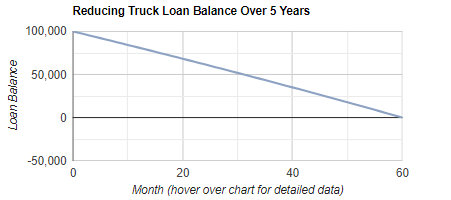
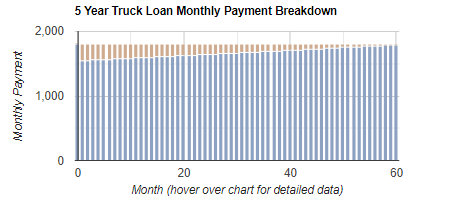
The following amortisation graphs detail month-by-month data on the progress of the proposed loan. The first chart below examines the reducing loan balance over the course of the finance contract term. The second graph illustrates the portion of each monthly repayment allocated to payment of interest vs principal reduction.
How to use our Truck Loan Repayment Calculator
Our Truck Loan Repayment Calculator helps Australian drivers and businesses estimate loan repayments before you commit. It is designed to support budgeting, cash flow planning, and comparing truck finance scenarios by showing how changes to price, deposit, term, and interest rate can affect your repayments and total interest cost.
How to complete the calculator for the most accurate estimate
1. Purchase Price
Enter the total purchase price of the truck you plan to finance. Consider including eligible on-road and purchase-related costs that may be financed (for example registration, insurance, or other costs where applicable). Use whole numbers only, without commas or decimals.
2. Deposit or Trade-in Value
If you are paying an upfront deposit or using a trade-in, enter that amount here. This reduces the amount you need to borrow and can lower repayments and total interest. Use whole numbers only.
3. Term of Loan (Years)
Select the loan term in years. In general, a longer term can reduce the periodic repayment but may increase the total interest paid over the life of the loan. Choose a term that suits your expected truck usage and business cash flow.
4. Interest Rate (Percent per annum)
Select an interest rate to model your scenario. Rates vary by lender and borrower circumstances, so it can be helpful to test a conservative rate as well as an optimistic one.
5. Calculate
Select calculate to generate your repayment estimate and repayment breakdown visuals.
How to interpret your results
1. Repayment estimate
Use this as a guide to affordability and budgeting. If the repayment is tight, test a higher deposit, shorter term, or different interest rate.
2. Amortisation and graphs
Review how the loan balance reduces over time, and how each repayment typically shifts from mostly interest early on to more principal later. This can help with planning for refinancing, early payout, or upgrade timing.
ASIC compliance note: This calculator provides information only and is not financial or credit advice. Results are estimates and may not include all fees, charges, taxes, residuals or balloon payments. Consider your objectives and financial situation, and seek independent advice or a lender quote before proceeding.
When it comes to securing a loan, the terms you agree to can have a lasting impact on your financial wellness. It's crucial to strike a balance between finding a loan that fits your needs and maintaining a healthy credit score. This delicate equilibrium is where loan comparison tools come into play, serving as navigational aids in the vast sea of credit options. - read more
As we navigate the complexities of today's economy, the significance of credit can scarcely be overstated. Whether we're considering a home mortgage, a new car, or managing our personal finances, our credit health often dictates the terms and accessibility of financial support. A robust credit score can open doors to favorable loan terms and rates, while a poor score can narrow our options and cost us more in the long run. - read more
Understanding the mechanics behind credit scores is pivotal for anyone navigating the intricate world of finance. A strong credit score does not only unlock the gates to a plethora of borrowing options but also secures favorable interest rates, which can save you a substantial amount of money over time. It acts as a financial passport, one that enables you to achieve milestones such as purchasing a home or car with ease. - read more
Financial health refers to the state of one's personal financial situation. It encompasses a variety of factors, such as income stability, expenses control, savings, investments, and debt management. - read more
Being declined for a loan because of your credit score can be frustrating, but it can also give you useful information. By reviewing the reason for the decision, checking your credit report and improving the factors lenders assess, you can be better prepared before considering another application. - read more
Let's dive into the essential topic of emergency funds. An emergency fund is a stash of money set aside to cover the financial surprises life throws your way. These unexpected events can include sudden unplanned repairs, medical emergencies, or job loss. - read more
Understanding the nuances of financial health is a crucial component in the journey of loan acquisition. It is the bedrock on which potential borrowers build their case for credibility and reliability. Among the myriad of factors influencing your fiscal stability, credit scores stand out as a beacon indicating your creditworthiness to lenders. A robust credit score simplifies the path to securing loans, garnering favorable interest rates, and negotiating better terms. - read more
Financial stress is a common issue that affects a large portion of individuals, often due to unexpected expenses, unemployment, or a high cost of living. It can lead to both mental and emotional strain, influencing one's quality of life and decision-making abilities. Credit scores, a critical measurement of financial health, are used by lenders to evaluate the risk of lending money. - read more
Managing debt early in adult life can make day-to-day money decisions easier and help build a more stable financial foundation. This guide explains practical ways to understand what you owe, create a workable budget, choose a repayment strategy, use credit carefully and know when to seek professional support. - read more
No-credit-check and bad-credit loans are not automatically illegal in Australia, but regulated consumer lenders generally still need to assess whether credit is suitable and affordable. This guide explains responsible lending, borrower protections, hardship rights and warning signs to check before applying. - read more
The Reserve Bank of Australia's decision on 29 September 2026 to lift the cash rate target by 25 basis points to 4.60 per cent has put loan affordability back in focus for households and small business operators already managing higher everyday costs. While the cash rate does not mechanically set every personal loan or short-term credit price, it influences funding costs, lender risk settings and the way borrowers think about repayment buffers. - read more
Small business finance is again in focus as more Australian operators look for ways to manage tax debts, supplier bills and uneven cash flow. Recent finance sector commentary points to a practical shift: lenders are still willing to consider funding requests, but they are looking more closely at whether a business can realistically service new repayments while existing obligations remain under pressure. - read more
Fresh financial complaints data has kept Australia’s lending sector under pressure, with consumer credit issues remaining a major concern for households already dealing with higher everyday costs. While the figures cover a broad range of products, the message for borrowers is clear: the way a lender assesses, explains and manages a loan can matter just as much as the advertised rate. - read more
Australian lending is continuing to shift towards faster, data-led assessment, with more providers using bank transaction history, income patterns and real-time affordability checks to understand whether a borrower can manage repayments. For people who have been knocked back by a mainstream bank, this is an important development because it can reduce the emphasis on a single credit score and place more weight on what is happening in the borrower’s finances today. - read more
Australia’s credit sector is facing renewed pressure to treat financial hardship as a core borrower protection, not a back-office process. The latest lending market focus is on how quickly and fairly credit providers respond when customers say they are struggling, especially as household budgets remain stretched by rent, utilities, groceries and existing debt commitments. - read more
Australia's buy now pay later sector is moving into a more regulated era, with providers being brought closer to the consumer credit framework that already applies to many personal loans and credit products. For borrowers, the practical message is simple: short-term convenience is being matched with stronger scrutiny around affordability, hardship support and responsible lending. Find out now if you qualify and compare rates, offers and options from multiple lenders - without a credit check! - read more
Recent personal loan market updates suggest Australian borrowers are seeing more competition in some parts of the lending market, but the benefits are not being shared evenly. Secured borrowers with stable income and strong repayment histories may find sharper advertised rates, while people applying for unsecured loans, short term loans or specialist bad credit loans still face a more complicated pricing picture. - read more
Recent personal lending updates from Australia’s loan comparison market suggest borrowers are still facing a mixed environment. While some advertised rates have become more competitive, unsecured personal loan pricing remains uneven, especially for applicants who do not fit a mainstream bank profile. For Australians with limited credit history, casual income, self-employment or past repayment issues, the headline rate is only one part of the decision. - read more
Debt consolidation is moving back into focus as Australians continue to balance higher living costs, credit card balances, buy now pay later commitments and personal loan repayments. Recent finance sector commentary suggests more borrowers are looking for ways to simplify their debts, not necessarily to borrow more, but to make existing obligations easier to manage. - read more
Australia’s fast-growing private credit market is again under the regulatory spotlight, with ASIC warning that borrowers, investors and superannuation members may be more exposed to private lending risks than many realise. The latest concern centres on a sector that has expanded as banks have become more selective, especially in areas such as property development, construction finance and specialist business lending. - read more
All finance quotes are provided free and without obligation. We respect your
privacy.
Knowledgebase
Private Mortgage Insurance (PMI): A type of insurance that a borrower might be required to purchase as a condition of a conventional mortgage loan, if the down payment is less than 20% of the property value.